
FREE DOWNLOAD
There's a date where your patient's allied health quietly stops.
Eighteen months from the last time you touched their plan. Nothing in your software warns you, and nobody finds out until a referral is refused at the front desk. Get the free framework and build the recall that catches it.
Instant download. Subscribe to our newsletter. No spam, just practical GP updates. Unsubscribe anytime.
THE COST OF A BLIND SPOT
Nobody tells you the day it stops.
The GPCCMP replaced GP Management Plans and Team Care Arrangements on 1 July 2025. Most practices updated their item numbers and left their recall settings exactly where they were.
The Bounce
Your patient turns up to the physiotherapist and the referral can't be claimed. They pay full fee or go home, and the first you hear of it is a phone call.
The Rewrite
Twenty minutes retyping a plan that only needed a review. Medicare never asked you to redo it annually. That habit is entirely ours.
The Blind Spot
No software flags an ageing plan. No alert, no colour change, no task on your list. You find out one patient at a time.
The Unused
Five allied health sessions. Five nurse services. Eight group diabetes sessions. Most go unclaimed because nobody explains what the plan actually buys.
WHAT YOU GET IN THE FRAMEWORK
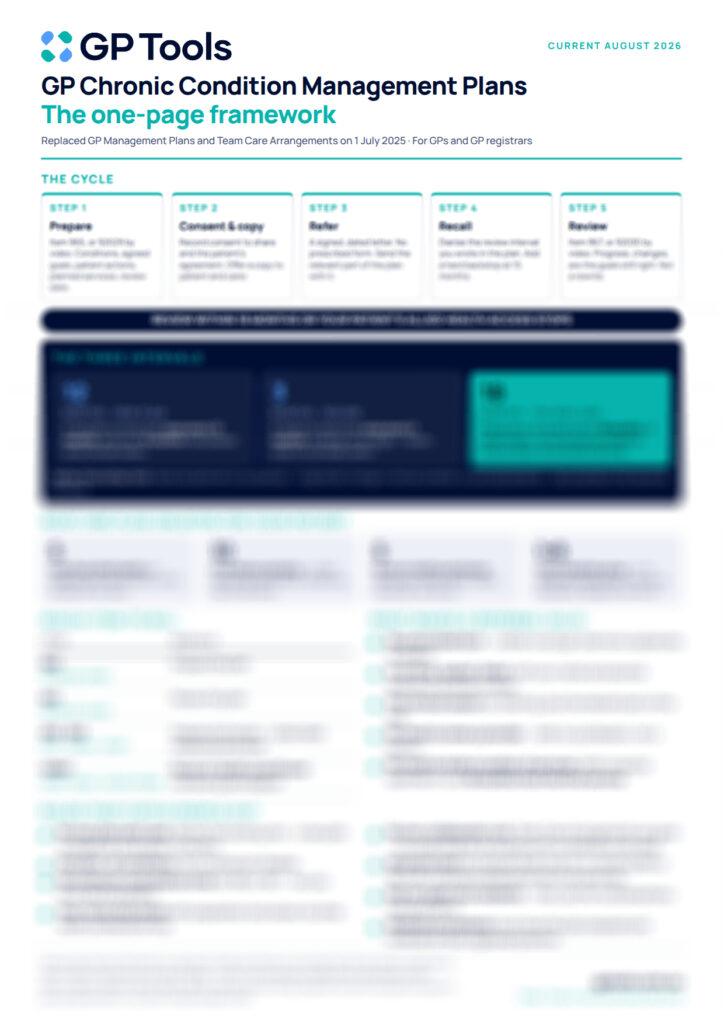
One page. The entire GPCCMP pathway covered.
Written by a practising Australian GP, referenced line by line to the MBS explanatory notes, and built to sit next to your monitor rather than in your downloads folder.
The three intervals
Twelve, three and eighteen months — and which one your recall should actually be built on. Get this wrong and everything downstream fails quietly.
Every current item number
965, 967, their video equivalents, 10997 and the allied health ranges. What each is for, how often you can claim it, and what you cannot co-claim.
The recall system
The list to pull this week, the backstop date to set, and what your practice nurse can own between reviews so plans stop ageing out.
WHY WE MADE THIS
We've had the referral bounce too.
A patient books in because the podiatrist told them Medicare wouldn't cover it. You open the file and the plan was last touched nineteen months ago. Nothing warned you, and now you're explaining Medicare instead of treating a foot. That appointment is the reason this page exists.
"It is not required that a new plan be prepared each year; existing plans can continue to be reviewed."
RACGP · CHANGES TO THE CHRONIC DISEASE MANAGEMENT FRAMEWORK, FAQs
HOW IT WORKS
Three steps to a plan that never lapses.
1
Download it
Enter your email. Instantly download the PDF.
2
Fix your recall
Change the twelve-month default to the plan's own review interval, and add a hard backstop at fifteen months.
3
Review, don't rewrite
Item 967. The plan stays where it is. You keep it true, and your patient keeps their access.
THE SHORT VERSION, IF YOU'D RATHER READ IT HERE
What changed in July 2025, and what everyone still gets wrong
On 1 July 2025 the GP Management Plan (item 721) and Team Care Arrangements (item 723) were replaced by a single document: the GP Chronic Condition Management Plan. One plan now covers every chronic condition your patient has, prepared on item 965 and reviewed on item 967. The old obligation to consult two other providers before you could refer is gone — you write the referral yourself, and a plan with no referrals at all is still a valid plan.
Most of that landed fine. What didn't land is the timing. There are three numbers in the new framework, and almost everyone quotes the wrong one. A new plan can be prepared once every twelve months, and only if three months have passed since the last review. A review can be claimed once every three months. But the number that actually governs your patient's care is eighteen: if the plan has not been prepared or reviewed within eighteen months, their access to allied health, the practice nurse items and group diabetes services stops. Nothing in your software marks that date.
Eligibility is wider than most people assume. One medical condition that has been, or is likely to be, present for at least six months — or that is terminal. There is no prescribed list of conditions; it is your clinical judgement about who would benefit from a structured approach. Community patients and admitted private hospital patients qualify. Permanent residents of aged care facilities do not — they use the multidisciplinary care plan items instead.
What one plan actually unlocks is more than most patients are told. Five individual allied health services per calendar year on items 10950–10970, each at least twenty minutes. Ten in total for Aboriginal and Torres Strait Islander patients, combining those with items 81300–81360. Five practice nurse or health practitioner services on 10997, 93201 or 93203 combined. And for patients with type 2 diabetes, one individual suitability assessment followed by up to eight group services — separate from the five, not counted within them.
Referrals got simpler, and most templates haven't caught up. There is no prescribed form. A letter is enough, provided it is in writing, signed and dated, carries your name and either your practice address or provider number, and explains the clinical reason for referring. You do not have to name a specific provider — the referral is to a profession — and you do not have to state a number of services. If you specify no period, the referral runs for eighteen months from the date of the first service.
A note on what this is. The framework is general educational information for registered health practitioners in Australia. It is not clinical, billing or legal advice. Item numbers, requirements and schedule fees change, and they index every July — so the guide points you to MBS Online and names the explanatory notes rather than quoting fees that will be stale by the time you read them. Separate transition arrangements apply to plans prepared before 1 July 2025.
FREE DOWNLOAD
Get the GPCCMP Framework
The three intervals, every current item number, and the recall system that catches a plan before it lapses. Four pages, plus a one-page cheat sheet you can print.
You'll also subscribe to our free newsletter for MBS and PBS updates. No spam. Unsubscribe anytime.